
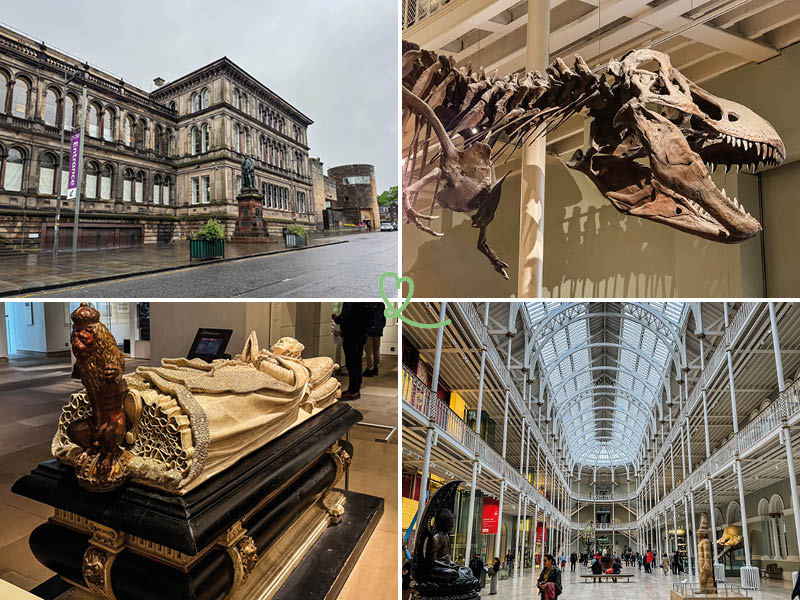
Visiting Edinburgh? Don’t miss the National Museum of Scotland! This emblematic institution of the Scottish capital houses one of the UK’s richest collections. We enjoyed the diversity of its 36 galleries spread over 7 floors. The visit is a captivating journey through science, art and history.
In this article, you’ll find some useful tips to help you prepare for your visit and have a wonderful time!
This opinion is completely independent, based on our experiences. We visited the region anonymously, making our own choices and paying our bills in full.
Why visit the National Museum of Scotland
Is the National Museum of Scotland worth it? Our opinion:
Yes, the National Museum of Scotland is definitely worth a visit. We were impressed by the richness of its collections, which cover everything from natural science and technology to world cultures and Scottish history. The building’s remarkable architecture blends Victorian style with contemporary extensions. The National Museum of Scotland is, in our opinion, one of the best things to do in Edinburgh!

Why is the National Museum of Scotland famous?
The museum is internationally renowned for a number of reasons:
- Here you’ll find Dolly the sheep, the world’s first cloned mammal and now a global scientific icon.
- The collections relating toScottish history are among the most comprehensive, with unique artifacts such as the reconstructed tomb of Mary Stuart.
- The museum is also distinguished by its hybrid architecture. The Victorian building from 1866 and the modern extensions from 1998 create a stunning architectural ensemble on Chambers Street.

Our favorite moments
In addition to our keen interest in the collections, which we’ll share with you later in this article, we loved it:
- The Grande Galerie and its magnificent glass roof, the architectural heart of the museum
- The Millennium Clock and its regular mechanical animations
- The panoramic view from the 7th floor terrace, an unforgettable view of Edinburgh and its castle (even in the rain!).
- The small space on the 3rd floor dedicated to ceramics.

WHERE TO STAY IN Edinburgh
Our favorites: neighborhoods and hotels
Our selection is coming soon Hotel 1 – See prices, photos and availability
Our selection is coming soon Hotel 1 – See prices, photos and availability
Our selection is coming soon Hotel 1 – See prices, photos and availability

See our complete selection of the best hotels in Edinburgh (coming soon)
History in brief
The history of the National Museum of Scotland is built around several milestones:
- 1866: Opening of the Victorian building on Chambers Street, designed by David Bryce in the Scottish Renaissance Revival style.
- 1904: Museum extension to accommodate growing collections
- 1998: Merger with the Royal Museum to create the National Museum of Scotland
- 2011: Major £47 million renovation, and creation of 16 new galleries
- 2016: Opening of new galleries dedicated to science and technology

Access: National Museum of Scotland, Edinburgh
Where is the National Museum of Scotland?
The National Museum of Scotland is located in Chambers Street, Edinburgh (EH1 1JF).
- In Edinburgh city center, in theOld Town district
- 5min walk from the Royal Mile and Edinburgh Castle
- Close to the University of Edinburgh and Grassmarket

RENT YOUR CAR IN Scotland
- Compare prices on our preferred platform: DiscoverCars – one of the best rated sites.
- Choose a car that’s not too wide, as some roads have only one lane.
- Book early for choice.

See our tips (coming soon)
How to get there?
The museum is within easy reach of central Edinburgh.
- From Waverley station, it’s a 10-minute walk up to the Royal Mile.
- Regular bus routes stop nearby.
- If you’re planning to visit the museum as part of a city tour, you can opt for a multi-stop bus that will leave you in front of the museum. See prices, photos and availability.

Parking
- Parking in Edinburgh’s historic center is limited, and there are a few on-street pay spaces, but they are rare.
- The NCP Edinburgh Castle Terrace parking lot is an 8-minute walk away, while the Blackfriars St car park is only 6 minutes away.
- For a leisurely visit, take public transport or walk from your accommodation if you’re staying in the city center.

discover edinburgh
- What to do in Edinburgh (coming soon)
- Best hotels (coming soon)
- Best restaurants (coming soon)

Useful tips: duration, schedules, eating…
Best time to visit
We found that the National Museum of Scotland is a very busy museum. It’s always a bit crowded, especially on rainy days, which are relatively common in Edinburgh. Sunny weekday afternoons can be quite peaceful.

Length of visit and main difficulties
- Allow at least 3 hours for a complete visit, 4 hours if you wish to see everything in detail.
- The museum covers 7 floors with 36 galleries: plan your visit according to your interests.
- Access is fully adapted for people with reduced mobility thanks to the elevators.
- Free changing rooms are available at the entrance.

Advice on how to visit
We began our visit in the main gallery. This allows you to get an immediate feel for the building’s architecture. We then gradually climbed to the upper floors. After a break at the Balcony Café, we returned to the tower to finish the tour on the 7th floor terrace, with its panoramic view of the city.
Pick up a free map at reception to help you find your way around this vast complex.

PLAN YOUR DREAM TRIP AROUND scotland
All the information you need for your trip:
- 15 maps for easy planning
- + 170 pre-selected locations
- Practical advice
- + 170 photos to help you choose

Visiting with children
- The museum is perfectly suited to families.
- Children love the animal gallery, with its life-size T-Rex and numerous interactive features, but there are also discovery trails, and we spotted an adventure area entirely dedicated to them on the 5th floor.
- More info here

Schedules and rates
- The museum is open daily from 10am to 5pm. Closed on December 25 and January 1 only.
- Admission to all permanent collections is completely free, making it one of Edinburgh’s most accessible attractions.
- Only certain temporary exhibitions may be subject to a charge.
- Visit the official website for more info here.

Guided tours
- Free guided tours are offered daily.
- Audioguides are also available in 5 languages (English, German, Spanish, French and Chinese) via the Smartify app. During our visit, they offered 3 different themes: the must-sees, LGBTQIA+ stories and a mindfulness trail to explore the museum in complete serenity.

Catering
We spotted 2 restoration points within the museum grounds:
- The Museum Kitchen on the first floor offers modern Scottish cuisine in elegant surroundings.
- For a quick break, the Balcony Café on the 3rd floor offers sandwiches, pastries and hot drinks.

Explore the natural and scientific worlds of the main building
The Grande Galerie and the Millennium Clock, between light and mechanics
As soon as we entered the Grande Galerie, we were captivated by the magnificence of its Victorian glass roof, which bathes the space in exceptional natural light. This architecture of iron and glass, typical of the 19th century, creates a grandiose atmosphere in which visitors move harmoniously between the different galleries.

At the edge of the gallery and at the foot of the escalators, don’t miss the Millennium Clock. We loved its mechanical animations, which are triggered regularly. Take your time to observe the details of this contemporary work of art, a veritable technical feat that blends traditional watchmaking with modern innovation.

Dolly the cloned sheep at the heart of technological innovation
In the section dedicated to cutting-edge technologies, we searched for and found the famous Dolly! This pretty sheep has become a worldwide symbol of the scientific advances of the 20th century. Displayed in a showcase on a specially-designed circular base, she is enthroned at the heart of technological innovation.

A life-size T-Rex in the Animal World Gallery
The “Natural World” gallery impressed us with its imposing tyrannosaurus rex skeleton, which majestically dominates the space. The dimensions of this prehistoric predator, perfectly reconstructed using modern paleontological techniques, are spectacular.

Around this giant of ancient times, you can admire a remarkable collection of naturalized specimens that trace the evolution of life on Earth. Well-designed interactive displays allow you to explore past and present biodiversity in detail, from the tiniest insects to the largest mammals.

Explore cultures, arts and everyday objects
Suspended pirogues in the maritime routes gallery
In the “Facing the Sea” room, we loved the traditional boats from Oceania that floated above the void. They bear witness to the extraordinary nautical skills of the Pacific peoples. Note the finesse of their construction, based on ancestral techniques handed down from generation to generation.

Around these masterpieces, you’ll discover a fascinating array of objects linked to global navigation. The exhibition reveals how the oceans have always been routes of cultural exchange rather than barriers, linking civilizations through millennia of maritime routes that you can retrace thanks to the interactive features on display.

Egyptian mummies and Buddhist statues in sacred collections
Galleries devoted to ancient Egypt and Asia transported us into the mysterious world of millennia-old spiritual beliefs. We were particularly struck by the presence of authentic mummies, preserved with consummate skill by ancient embalmers. The funerary objects that accompany them tell a vivid story of Egyptian beliefs about the afterlife.

In the Asian section, you’ll be struck by the serenity emanating from the Buddhist sculptures, from Burmese Buddhas to Chinese bodhisattvas. Each expresses a particular philosophy of spiritual awakening. We found it fascinating to compare these different approaches to the sacred, from the elaborate rituals of Pharaonic Egypt to the contemplative meditation of Buddhism. They are universal testimonies to the human quest for transcendence.

An 18th-century Mantua dress in the fashion gallery
In the “Fashion and Style” exhibition, we loved this 18th-century Mantua court dress. It epitomizes the splendor and constraints of the European aristocracy of the Ancien Régime. This spectacular piece, with its precious fabrics and extraordinarily fine embroidery, revealed the complex dress codes that governed society at the time.

This gallery brilliantly traces the evolution of fashion as a mirror of social transformations, from restrictive crinolines to the contemporary sartorial revolutions you’ll discover along the chronological trail.

Sounds, instruments and moods in the temporary music exhibition
The musical exhibition in progress at the time of our visit offered us a real sensory voyage, thanks in particular to its immersive approach. We enjoyed the diversity of the traditional instruments on display, and had fun testing them out to discover and compare their sounds.

A number of interactive devices allowed visitors to explore the manufacturing secrets and playing techniques specific to each musical tradition. The exhibition showed how music is a universal language that crosses borders and unites peoples.

Tracing Scottish history on the Tower’s floors
From Celtic stones to Mary Stuart’s tomb
The first levels of the Tower plunged us into Scotland’s most ancient roots, from the mysterious stelae carved by the Picts to the sumptuous artefacts of the Scottish Renaissance. We particularly liked a bas-relief called The Deer Hunt, depicting a stag hunt. This carved stone bears witness to the narrative art of the Picts.

The highlight of this historical tour is the symbolic reconstruction of the tomb of Mary Stuart, a tragic and emblematic figure in Scottish history. Her personal objects, from her jewels to the political documents that sealed her fate, moved us. This section traces the tumultuous history of medieval Scotland, from Viking invasions to the Wars of Independence.

Industrial machinery and everyday life in the Victorian era
The Tower’s intermediate levels took us back to industrial Scotland in the 19th century, a period of revolutionary transformation that forged the country’s modern identity. We saw monumental textile machines that showcase Scottish technical ingenuity and the meteoric rise of the Lowlands textile industry.

You’ll discover how the Industrial Revolution radically transformed everyday life in Scotland. Everyday objects produced on a large scale (crockery, furniture, clothing) illustrate the emergence of a consumer society and the gradual improvement in living conditions.

Panoramic view of Edinburgh from the museum terrace
The climb to the 7th floor finds its ultimate reward on the panoramic terrace, which offers an unobstructed view of Edinburgh. We stayed for a while, despite the rain, contemplating the panorama and trying to identify the main monuments of Scotland’s capital. The castle perched on its volcanic rock was a hideout in the mist, helping us to rediscover the winding lanes of Old Town and, beyond, the geometric order of New Town.

Subscribe to our Newsletter
- Get away from it all with Region Lovers’ beautiful destinations!
- Once a month
- Advertising-free

Frequently asked questions
Do I need to book in advance?
Admission is free and no reservation is required.

Is Dolly the real thing?
Yes, the Dolly sheep on display at the National Museum of Scotland is the real Dolly, the one who made scientific history by becoming, in 1996, the first mammal cloned from an adult cell. She was cloned at the Roslin Institute, a few miles from Edinburgh, and lived until 2003. After her death, she was naturalized (taxidermy) and integrated into the museum’s collections.


