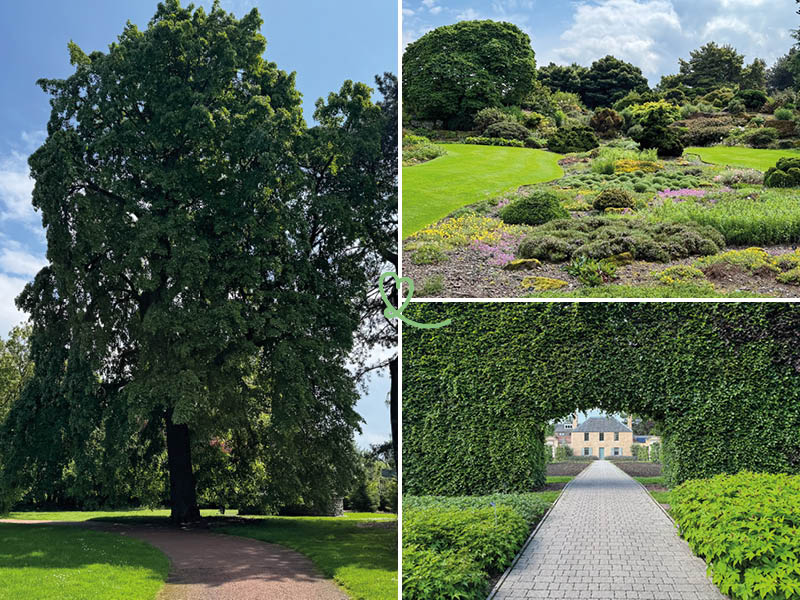
Visiting Edinburgh? Don’t miss the Royal Botanic Garden! This unique garden takes full advantage of Scotland’s very wet climate, and is home to over 10,000 species of plants. We were particularly taken by its magnificent landscapes, with majestic trees, water features and endless lawns.
In this article, you’ll find some useful tips to help you prepare for your visit and have a wonderful time!
This opinion is completely independent, based on our experiences. We visited the region anonymously, making our own choices and paying our bills in full.
Why visit the Royal Botanic Garden?
Is the garden worth it? Our opinion:
Yes, the Royal Botanic Garden is well worth a visit! We were amazed by its grandiose landscapes and the diversity of its botanical collection, which boasts over 14,000 plant species. Endless lawns, majestic trees and water features create a unique atmosphere. In our opinion, it’s one of the best things to do in Edinburgh!

Why is the Royal Botanic Garden famous?
Founded in 1670 as a medicinal plant garden near the Palace of Holyrood House, it is the second oldest botanical garden in the UK after Oxford. The garden was moved to its present location in Inverleith in 1820 to escape the pollution of the city. With its impressive collection of over 14,000 plant species and panoramic views of the city and Edinburgh Castle, it has become a major attraction.

Our favorite moments
During our visit, the garden enchanted us in many ways. But to name just 3:
- The gigantic trees that dominate the garden.
- The magnificent blue poppies also caught our eye, creating striking patches of color in the landscape.
- The Botanic Cottage, with its simple architecture and vegetable garden, remains one of our favorites.
- Please note that the greenhouses were unfortunately closed at the time of our visit for renovation.

History in brief
The Royal Botanic Garden underwent several moves before settling on its current location:
- 1670: Founded by Robert Sibbald and Andrew Balfour near the Palace of Holyrood House
- 1675: Expansion to a second site on the banks of Nor’ Loch
- 1695: Relocation to Holyrood following a flood
- 1763: Move to Leith to escape pollution
- 1820: Definitive establishment on the present-day site of Inverleith
- 1858: Construction of Palm House, Britain’s tallest building

How to get there: Royal Botanic Garden, Edinburgh
Where is the garden?
The Royal Botanic Garden is located in the north of the city, just above the trendy Stockbridge district. You’ll find it in Inverleith, about a mile from Edinburgh city center. The two main entrances are:
- The East Gate on Inverleith Row
- The west gate on Arboretum Place

RENT YOUR CAR IN Scotland
- Compare prices on our preferred platform: DiscoverCars – one of the best rated sites.
- Choose a car that’s not too wide, as some roads have only one lane.
- Book early for choice.

See our tips (coming soon)
How to get there?
Access by public transport is very convenient.
- The East Gate entrance on Inverleith Row is served by bus routes 8, 9, 23 and 27 from the city center.
- For the west entrance (John Hope Gateway Visitor Centre), take the 29 and 24 buses from Lothian via Stockbridge or the Majestic Bus T.

Parking
- Pay parking is available on the street near the garden’s west gate (John Hope Gateway) on Arboretum Place.
- For people with reduced mobility, six spaces reserved for blue badge holders are located near the west entrance.
discover edinburgh
- What to do in Edinburgh (coming soon)
- Best hotels (coming soon)
- Best restaurants (coming soon)

Useful tips: duration, schedules, eating…
Best time to visit
- We advise you to visit the garden as soon as the weather is fine!
- Spring (March to May) is particularly spectacular with its colorful blooms and mild temperatures.
- Summer offers long, sunny days ideal for enjoying the area to the full.
- Remember to wear layered clothing to adapt to temperature variations, especially in greenhouses.

Length of visit and main difficulties
- Allow 1 to 3 hours to explore the 70-acre garden.
- We didn’t encounter any particular difficulties on our visit, just follow the well-kept paths.
- The most suitable passages for PRMs are indicated.

Advice on how to visit
- We recommend you start your visit at the West Gate.
- Our route took us from the south-west of the garden to the Rock Garden, then on to Willow Pond and Chinese Hill.
- We then explored Inverleith House and Botanic Cottage, before finishing in the Scottish wilderness.

PLAN YOUR DREAM TRIP AROUND scotland
All the information you need for your trip:
- 15 maps for easy planning
- + 170 pre-selected locations
- Practical advice
- + 170 photos to help you choose

Visiting with children
The garden is perfect for introducing children to Mother Nature’s finest wonders. A 2.7 km path allows them to explore various fascinating areas such as the Chinese Hill and the Rocaille Garden. They’re sure to be impressed by the exotic greenhouses, home to over 2,400 special plants from all over the world, as soon as the renovation work is complete.

Schedules and rates
- The garden is open every day except January 1 and December 25.
- Times vary according to season: 10am-4pm in January, 10am-5pm in February, 10am-6pm from March to September, 10am-5pm in October, and 10am-4pm in November and December.
- Admission to the garden is free, but there is a charge for access to the greenhouses (£7 for adults).
- More info on the official website here

Guided tours
- Seasonal guided tours are offered daily at 11am and 2pm from April to October. Find out more here.
- A free audioguide is also available to enhance your visit.

Catering
Three establishments welcome you in the garden:
- The Gateway Café, located at the John Hope Gateway, offers seasonal dishes prepared with vegetables from the garden.
- The Terrace Café offers stunning views of the castle from Inverleith Lawn.
- The East Gate Coffee Bar, near the east entrance, serves excellent homemade pastries and specialty coffees.

Start of tour: from Wild Orchard to Rock Garden
We entered the garden via the West Gate and the John Hope Gateway center. From there, we headed south towards Wild Orchard.
- Our first stop was the Biodiversity Garden. This is a somewhat wild and free garden (in appearance only) where we were able to appreciate a wide variety of plant forms. Paths of freshly mown grass wind through the undergrowth.

- A little further on, the Slate Hole Wall is a sculpture by Andy Goldsworthy. It was created in collaboration with a wall-maker, Joe Smith. It’s made of Cumbrian slate. It blends perfectly into the landscape and looks a little like the Cairns, the circular funerary monuments found in the Highlands.

- Then it was on to the Rain Garden, just down the road, which surprised us. This is an experimental project designed to manage rainwater and reduce flooding. Here we found plants adapted to wet conditions that could offer a sustainable solution to the impacts of climate change.

- The John Muir Grove is a majestic circle of giant redwoods. Planted in the 1920s, the grove is named in honor of Scottish naturalist John Muir, father of the American National Parks. At the time of our visit, a wedding was being celebrated in this grandiose setting.

- Throughout the park, you’ll find memorial plaques, installed at the foot of trees or on dedicated benches. They are often in memory of botanists, researchers or enthusiastic amateurs, people who had a personal connection with the garden.

- Finally, we moved on to the Rock Garden. This is a rock garden with a great diversity of plants arranged on slopes and around a stream. The layout of this part of the garden is like a mini-landscape in which to wander and marvel at the variety of shapes, colors and foliage.

Continuation of the tour: Memorial Garden and Chinese Hillside
After the Jardin de Rocaille, the landscape changes completely in the shadow of a seemingly abandoned Jardin Sauvage. We followed the path, discovering more surprises before reaching the Colline Chinoise.
- The Memorial Garden for Organ and Tissue Donors continues the peaceful transition of our journey. It pays tribute to the donors who have saved or improved lives. It includes a dry-stone structure housing a book containing the handwritten names of Scotland’s donors.

- At several points in the park, we were able to enjoy the poetic spectacle of the handkerchief trees. We were lucky, as these trees, native to China, flower in May.

- Himalayan blue poppies are one of the Royal Botanic Garden’s signature plants. We loved these intense blue flowers, which bloom in spring and summer. Once again, we were lucky to be able to admire them.

- Just across the road, we enjoyed the peaceful setting of Willow Pond. This ornamental pond is surrounded by luxuriant vegetation and nestles a wealth of aquatic wildlife. A delightful moment of relaxation and observation.

- Behind the pond, a very old chestnut tree stands isolated in an enclosure. It’s one of the oldest trees in the garden. Its story surprised us. As it was beginning to wither, instead of felling it, it was decided to conserve as much wood as possible to transform it into a precious habitat.

- The Chinese Hillside, a little further to the left, is a haven of serenity, showcasing one of the world’s largest collections of Chinese plants. Here we found benches, a bridge and a small temple, all nestled in the vegetation around a water feature.

End of tour: Inverleith House to Botanic Cottage
The last part of our tour took us first to Inverleith House, ending our journey at Botanic Cottage.
- On our way out of Chinese Hill, we discovered Inverleith House. This historic building was constructed in 1774. Formerly the residence of the garden’s director, it now houses an art gallery combining contemporary art and botany. You’ll also find the Terrace Café here, where you can enjoy a siesta on the lawn.

- You have to turn around to admire the view of Edinburgh Castle from the lawn of Inverleith House. The rocky peak is particularly visible above the garden vegetation.

- Heading north, you can’t miss the rhododendron groves on either side of the path. Over 800 species flourish in the Royal Botanic Garden.

- Behind a high beech hedge, the small silhouette of Botanic Cottage stands out. It’s a little house, like the ones children draw, surrounded by an impeccably tended vegetable garden. We could have stayed there forever.

- To get back to West Gate and leave the garden behind, we passed through the wild Scottish forest, which immersed us in the authentic atmosphere of the Highlands.

Subscribe to our Newsletter
- Get away from it all with Region Lovers’ beautiful destinations!
- Once a month
- Advertising-free

Frequently asked questions
What are the rules of good behavior in the garden?
To preserve the beauty of the site, there are a few rules to follow to enjoy the garden and respect the plants. You must avoid climbing trees, damaging or uprooting plants, using scooters or bicycles, playing ball, running, smoking indoors and bringing pets.

Is it possible to picnic in the garden?
No, picnics are not permitted in the garden. However, you are welcome to use the lawns to relax and enjoy the scenery.