
The atmosphere at the Writers’ Museum in Edinburgh immediately struck us as very special. Nestled in the heart of Lady Stair’s Close, between old stones and narrow staircases, this literary museum transported us to another time. In a succession of hushed rooms, personal objects and fragments of stories led us to meet some of the major figures in Scottish literature.
In this article, you’ll find some useful tips to help you prepare for your visit and have a wonderful time!
This opinion is completely independent, based on our experiences. We visited the region anonymously, making our own choices and paying our bills in full.
Why visit the Writers’ Museum?
Is the Writers’ Museum worth it? Our opinion:
Yes, the Writers’ Museum is well worth a visit, especially if you’re interested in literature. The place is modest but steeped in history, with moving personal objects and a simple layout. Don’t expect an interactive or spectacular museum, but rather a quiet, timeless interlude. As admission is free, it’s also a great opportunity to discover a fundamental part of the local heritage.
For those of us who love literature, this is one of the best things to do in Edinburgh.

Why is the Writers’ Museum famous?
The Writers’ Museum is famous for celebrating three major figures in Scottish literature: Robert Burns, Walter Scott and Robert Louis Stevenson. Housed in Lady Stair’s House, a historic 17th-century house, it features personal objects, manuscripts and memorabilia relating to these authors. Its unique setting and intimate approach make it an emblematic place to discover Scotland’s literary heritage.

Our favorite moments
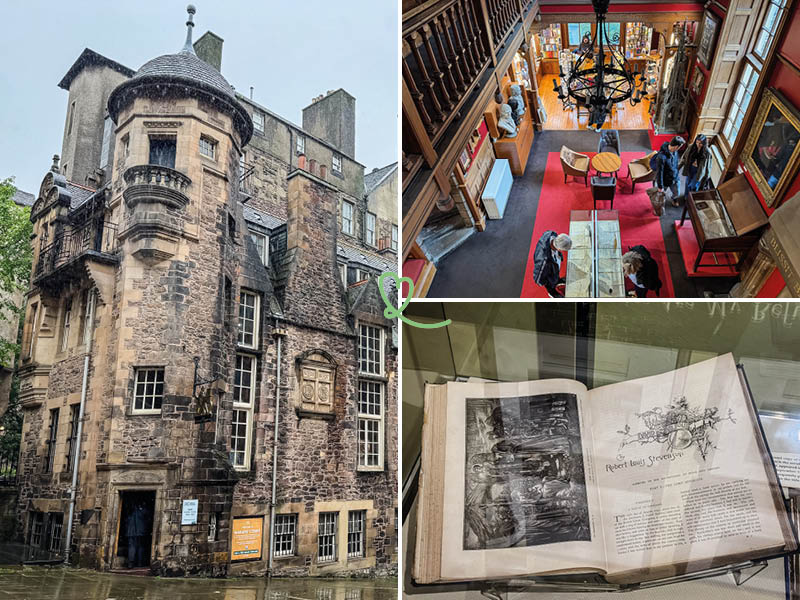
- Lady Stair’s House with its slender silhouette and stone stair tower. It seems to have been preserved from time, on the edge of a discreet courtyard. The layout gives the visit an intimate, almost secretive feel.
- The great hall with its mezzanine, an unexpected volume bathed in light even on rainy days. This is where you’ll find the store, with books by local writers.
- The intimate worlds of writers recreated through personal objects: a walking stick, a letter, a portrait… These fragments of life give the impression of entering their daily lives.

WHERE TO STAY IN Edinburgh
Our favorites: neighborhoods and hotels
Our selection is coming soon Hotel 1 – See prices, photos and availability
Our selection is coming soon Hotel 1 – See prices, photos and availability
Our selection is coming soon Hotel 1 – See prices, photos and availability

See our complete selection of the best hotels in Edinburgh (coming soon)
History in brief
Opened in 1953, the museum occupies Lady Stair’s House, itself built in 1622 and named after Elizabeth Dundas, widow of the Earl of Stair. The house was later donated to the city by Lord Rosebery, and restored to house a collection dedicated to Robert Burns, Walter Scott and Robert Louis Stevenson. The Writers’ Museum is now part of the Museums and Galleries Edinburgh network.

How to get there: Writers’ Museum, Edinburgh
Where is the Writers’ Museum?
- In the heart of Edinburgh, in historic Old Town
- Located in Lady Stair’s Close, a pedestrian alley accessible from the Royal Mile
- 2 steps from Edinburgh Castle
The museum’s address is as follows:
Lawnmarket, Lady Stair’s Close, Edinburgh EH1 2PA, Scotland

RENT YOUR CAR IN Scotland
- Compare prices on our preferred platform: DiscoverCars – one of the best rated sites.
- Choose a car that’s not too wide, as some roads have only one lane.
- Book early for choice.

See our tips (coming soon)
How to get there?
It’s easy to get to the museum, which is located in Edinburgh’s historic Old Town:
- On foot: 5min from Waverley station via the Royal Mile
- By bus: several lines serve the surrounding area, getting off at The Mound or Victoria Street.
- By car: access is not recommended, as the surrounding streets are pedestrianized and parking is very limited.
- Please note: the entrance is via a narrow alley with steps, which may pose a problem for people with reduced mobility.

Parking
If you’re coming by car, Blackfriars Street parking lot is a 10-minute walk from the Writers’ Museum.

discover edinburgh
- What to do in Edinburgh (coming soon)
- Best hotels (coming soon)
- Best restaurants (coming soon)

Useful tips: duration, schedules, eating…
Best time to visit
- The best time to visit is on weekday mornings, between 10am and 12pm.
- As the museum is small, with narrow rooms and staircases, it can quickly feel crowded when it’s busy. If you come early, you’ll enjoy a more leisurely visit.
- Weekends and afternoons attract more visitors, especially in summer.

Length of visit and main difficulties
- The visit lasts on average between 30 minutes and 1 hour, depending on how much time you devote to reading the panels and observing the objects.
- The tour takes in several floors linked by narrow staircases with irregular steps and sometimes very low ceilings. We learned that this was once a means of signalling ill-intentioned visitors!
- The Writers’ Museum is not accessible to people with reduced mobility.

Advice on how to visit
We began our visit with the Robert Burns area on the first floor, then moved up to the mezzanine, from where there’s a fine view of the main reception room. It’s on this floor that you’ll find the spaces dedicated to Walter Scott. At the very top, we found a reconstruction of the Ballantyne Primery. We then headed back down to the basement to discover the world of Robert Louis Stevenson.

PLAN YOUR DREAM TRIP AROUND scotland
All the information you need for your trip:
- 15 maps for easy planning
- + 170 pre-selected locations
- Practical advice
- + 170 photos to help you choose

Visiting with children
We didn’t notice any special facilities for children inside the museum. The space is narrow, with several steep staircases, which can make the visit less convenient with a stroller or for toddlers.

Schedules and rates
- The Writers’ Museum is open from 10 a.m. to 5 p.m.
- Admission is free
- More info here
Guided tours
- We didn’t see any guided tours offered in the museum.
- However, it is possible to take one as part of a walking tour of Edinburgh’s highlights. See prices, photos and availability.

Explore the world of Scottish writers
We liked the Writers’ Museum as much for its collections as for its atmosphere. The visit begins as soon as you approach the building.
A historic setting in a quiet lane
We entered the museum via a narrow passage, Lady Stair’s Close. It leads to a small cobbled courtyard, Makars’ Court, set slightly back from the hustle and bustle. The architecture of Lady Stair’s House, with its stone staircase tower, immediately sets the tone. It’s a preserved, almost secret space in the heart of a bustling city.

A few steps lead up to the door, past a discreet plaque. From the outset, we noticed that the place had retained a period atmosphere, with its rough walls, narrow windows and the echo of our footsteps on the stairs.
An intimate presentation of the collections
We liked the way the objects were spread out over several small rooms, sometimes half-lit, where you could move around slowly. We found dark wooden showcases, antique frames, objects lying there as if they’d always been there. This gives the visit a hushed, intimate feel.

As the spaces are cramped, we took the time to look at every detail. It’s a layout that forces a form of concentration: you read, you observe, you immerse yourself in the place and the world of the writers. The overall effect is sober, without overload or screens.

Three major figures in Scottish literature
The tour is structured around three emblematic authors, each occupying a distinct part of the building.
Words and memories by Robert Burns
In the first room, we discovered personal effects, a copy of his handwriting, letters and a few objects familiar to Robert Burns. The showcases highlight the emotion of the texts, with selected extracts presented in a simple manner. We could perceive the attachment of the Scottish public to this popular poet.

The way he is treated, however, is more about the man than the legend. Born into a rural environment in the 18th century, Robert Burns wrote in both Scots and English, dealing with everyday life, love, nature and social inequalities. His work is deeply rooted in his time, but continues to resonate in Scotland, notably through the Burns Night celebrated every January 25.

Walter Scott’s Romantic legacy
Upstairs, other areas are dedicated to the world of Walter Scott, with reconstructed furniture and several portraits. On display are memorabilia related to his historical works, as well as elements of his private life, such as his walking stick and spectacles. The exhibition evokes his role in the creation of a Scottish imaginary. The scenography remains classic, but effective.

It gives a good idea of the influence he has had, both in literature and in national identity. An early 19th-century author, Walter Scott is considered one of the pioneers of the historical novel. His stories, such as Waverley and Rob Roy, combine fiction and fact, helping to shape a romantic image of Scotland, with its clans, castles and wild landscapes.

Robert Louis Stevenson’s inner adventure
The basement of the museum is dedicated to Robert Stevenson. We saw travel objects, early sketches and photographs. It all adds up to a vivid, nuanced picture of the author. We understood his taste for travel, his attachment to writing, and a certain melancholy.

It remains one of the most memorable passages of our visit. Born in 19th-century Edinburgh, Stevenson is the author of such iconic novels as Treasure Island and The Curious Case of Dr. Jekyll and Mr. Hyde. His work oscillates between adventure, introspection and fantasy, nourished by a life marked by illness, travel and a lucid view of the human condition.

Women writers in the collections
Other Scottish writers feature in the museum, and we noticed that there were very few women. A discreet presence that you only notice if you take the time to look.
A discreet but significant presence
Here and there, we glimpsed the portraits of a number of Scottish authors. Names such as Nan Shepherd orHelen Cruickshank are integrated into the museum’s exhibits or featured in photo panels.

Even if their place is secondary, these elements show a willingness to include them, without devoting dedicated space to them. This leaves a feeling of incompleteness, but nonetheless makes you want to discover more elsewhere.

Highlighting absence to raise questions
What we don’t see is as striking as what we do see. The paucity of content relating to women writers reminded us of their historical erasure. This absence can be read as a call to explore other paths. It invited us to broaden our definition of literary heritage, and to question what is authoritative in museographic choices.

The Writers’ Museum’s Mary Ratcliff Writer’s Room Programme, launched in 2025, responds precisely to this concern by showcasing women writers, hitherto marginalized in literary history. This initiative helps to rebalance representation and enrich our understanding of literary heritage in all its diversity.
Subscribe to our Newsletter
- Get away from it all with Region Lovers’ beautiful destinations!
- Once a month
- Advertising-free

Frequently asked questions
Is there a store or café on site?
There is a store, but no café in the museum. However, there are several nearby establishments on the Royal Mile.

How many languages are available for texts and labels?
Most texts are in English only. We didn’t see any translations available on site.


