
Staying in Edinburgh? Don’t miss St Cecilia’s Hall & Music Museum! This unique institution combines an 18th-century concert hall with an exceptional museum of early instruments. A remarkable collection that traces musical evolution through the centuries.
In this article, you’ll find some useful tips to help you prepare for your visit and have a wonderful time!
This opinion is completely independent, based on our experiences. We visited the region anonymously, making our own choices and paying our bills in full.
Why visit St Cecilia’s Hall & Music Museum
Is St Cecilia’s Hall & Music Museum worth it? Our opinion:
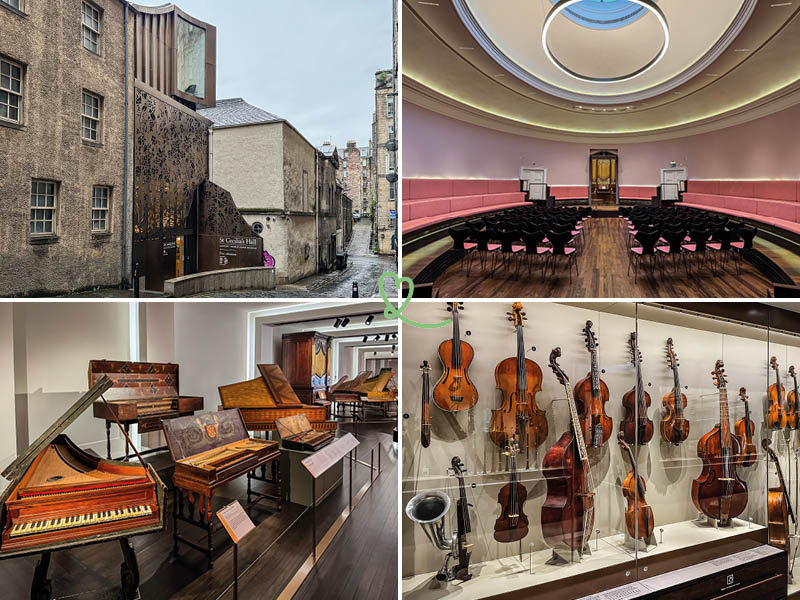
Yes, it’s well worth a visit. This unique institution combines a historic concert hall, the oldest in Scotland. Theacoustics are exceptional and the architecture fluid and elegant, all in an authentic 18th-century setting. We were also impressed by the diversity of the collection of early instruments on display.
In our opinion, it’s one of the best things to do in Edinburgh!

Why is St Cecilia’s Hall & Music Museum famous?
The establishment is famous for several reasons:
- It houses Scotland’s oldest concert hall, built in 1763. This historic hall hosted concerts by St Cecilia’s Society, Scotland’s oldest musical society. Concerts are still held here today.
- The museum is also renowned for its exceptional collection of early instruments, including Ruckers harpsichords and rare instruments such as the euphonicon.

Our favorite moments
You’ll find out more about our tour in a moment, but here are the things we think you shouldn’t miss:
- The Sypert Concert Room, with its refined decor and superb acoustics
- The Ruckers harpsichords in the Binks gallery, real jewels of early craftsmanship
- Theeuphonicon, a unique instrument halfway between a piano and a harp.

WHERE TO STAY IN Edinburgh
Our favorites: neighborhoods and hotels
Our selection is coming soon Hotel 1 – See prices, photos and availability
Our selection is coming soon Hotel 1 – See prices, photos and availability
Our selection is coming soon Hotel 1 – See prices, photos and availability

See our complete selection of the best hotels in Edinburgh (coming soon)
History in brief
Here are the milestones in the history of St Cecilia’s Hall & Music Museum:
- 1728: Founding of St Cecilia’s Society, Scotland’s oldest musical society
- 1763: Robert Mylne builds St Cecilia’s Hall, Scotland’s first concert hall
- 1801: Dissolution of the St Cecilia’s Society and change of use of the building
- 1960: Acquisition by the University of Edinburgh
- 1968: Opening of the Museum of Musical Instruments
- 2017: Major renovation and reopening with new galleries

How to get there: St Cecilia’s Hall & Music Museum, Edinburgh
Where is St Cecilia’s Hall & Music Museum?
St Cecilia’s Hall & Music Museum is located at 50 Niddry Street in Edinburgh city center (EH1 1LG).
- In Edinburgh’s OldTown
- Close to the University of Edinburgh
- Close to the Royal Mile and Edinburgh Castle

RENT YOUR CAR IN Scotland
- Compare prices on our preferred platform: DiscoverCars – one of the best rated sites.
- Choose a car that’s not too wide, as some roads have only one lane.
- Book early for choice.

See our tips (coming soon)
How to get there?
The museum is within easy reach of Edinburgh’s Old Town.
- From Waverley station, it’s a 10-minute walk up the Royal Mile.
- Regular bus routes stop nearby.
- If you’re planning to visit the museum as part of a city tour, you can opt for a multi-stop bus that leaves you right next to the museum. See prices, photos and availability.

Parking
- Limited parking in Edinburgh’s historic center
- Blackfriars St parking lot is just 2 minutes away.
- We recommend using public transport to reach the Royal Mile, especially as the area is mainly pedestrianized.

discover edinburgh
- What to do in Edinburgh (coming soon)
- Best hotels (coming soon)
- Best restaurants (coming soon)

Useful tips: duration, schedules, eating…
Best time to visit
- The museum is generally quiet, but more so on weekdays and outside the Edinburgh Festival periods.
- We recommend visiting in the morning to take full advantage of the concert hall’s acoustics.
- If you’d like to attend a concert, check out the online program, as events are regular but limited in number of seats. Find out more here.

Length of visit and main difficulties
- Allow around 1 hour to visit the museum.
- The building is equipped with an elevator for access to the various galleries.
- Seating is provided for breaks in the various rooms.
- There are toilets on the first floor.
- Assistance dogs are welcome.

Advice on how to visit
We began our tour on the second floor (Binks and 1812 galleries, Sypert Concert Room) before descending to the first floor (Wolfson gallery and Laigh Hall).

PLAN YOUR DREAM TRIP AROUND scotland
All the information you need for your trip:
- 15 maps for easy planning
- + 170 pre-selected locations
- Practical advice
- + 170 photos to help you choose

Visiting with children
We found an activity booklet for children aged 6 and over. Pea the Peacock, a young peacock, guides them through a questionnaire, with the chance to win a small gift at the end of the visit. Theapp you can download onto your phone will help them solve the riddles.

Schedules and rates
The museum is open Tuesday to Saturday, 10am to 5pm.
Rates:
- Free admission for all
- Voluntary donations accepted
Visit the official website for more info here.

Guided tours
- A QR code application can be downloaded to your cell phone to accompany your visit.
- One-hour guided tours are available on reservation.
- Museum staff are on hand to answer questions and provide further information on the instruments on display.

Catering
The museum doesn’t have a café, but the Royal Mile is full of dining options. You’ll find many traditional pubs and restaurants just a few steps away. The Inn on The Mile Restaurant, located in a historic building, offers authentic pub food just a 2-minute walk from the museum. It’s one of our favorite restaurants in Edinburgh.

Explore St Cecilia’s Hall: vintage instruments and a historic concert hall
Admire antique keyboard instruments in the Binks and 1812 galleries
The Binks and 1812 galleries house an exceptional collection of early keyboard instruments, fascinating us with their diversity and quality. You’ll find spinet, harpsichord and clavichord instruments from the 16th to the 19th centuries. We were particularly impressed by the beautifully decorated Ruckers harpsichords. They are considered to be the finest instruments of their time.

Here you’ll find a rather spectacular euphonicon and a chamber organ we really liked. We found the idea of having an organ at home particularly appealing. Each instrument is accompanied by detailed explanations of its construction and use, allowing you to understand the subtleties of early organ building.

Visit the Sypert Concert Room, Scotland’s oldest concert hall
The Sypert Concert Room is the historic heart of St Cecilia’s Hall, transporting us back to the musical ambience of the 18th century. This concert hall, built in 1763 and now renovated, retains its exceptional acoustics, which made it an ideal venue for chamber music concerts. We were able to admire the elegance of this oval hall, which continues to host contemporary concerts, perpetuating its original musical vocation in a preserved historic setting.

Understanding the evolution of musical instruments over the centuries
The Wolfson Gallery: winds, strings and percussion in chronological order
The Wolfson Gallery took us on a journey through the history of musical instruments. The instruments are displayed chronologically. We appreciated this approach, which enabled us to follow the evolution of instrument-making techniques and musical tastes over the centuries. Don’t miss the traditional Scottish bagpipes, as well as a remarkable collection of drums and percussion instruments.

The exhibition also features rarer instruments such as an enormous snake double bass, a wind instrument with sinuous shapes that intrigued us greatly. Each showcase tells the story of a particular era and musical culture. This enables us to understand how instruments evolved according to the artistic needs and technical possibilities of their time.

Laigh Hall: music as language and space for sharing
In Laigh Hall, the focus is on music as a form of communication. We discover how collective play creates bonds, through concrete examples and accessible devices. The space invites us to reflect on the social and emotional dimensions of music, beyond scores.

The space also houses the Dunard studio, dedicated to the preservation and restoration of early instruments, where we could imagine the painstaking work of luthiers and restorers. The museum’seducational approach enabled us to better understand the links between early and contemporary music, making this visit an enriching experience for all ages.

Subscribe to our Newsletter
- Get away from it all with Region Lovers’ beautiful destinations!
- Once a month
- Advertising-free

Frequently asked questions
Do the instruments on display come exclusively from Scotland?
No, the St Cecilia’s Hall collection includes instruments from all over Europe. Although some of the instruments are Scottish in origin, the international collection traces the evolution of European music. You’ll find German, French, Italian and English instruments, reflecting the cultural and commercial exchanges of the time.

Why is the museum named after Saint Cecilia?
Saint Cecilia is the patron saint of musicians in the Christian tradition. The St Cecilia’s Society of Edinburgh, founded in 1728, chose this dedication to honor the patron saint of music. The hall’s name perpetuates this tradition and recalls the importance of sacred music in 18th-century Scottish culture.

