
Spending a few days in Edinburgh? Don’t miss the Palace of Holyroodhouse! This is the official royal residence of the current British monarchy in Scotland. Its dark silhouette stands majestically at the bottom of the Royal Mile, at the foot ofArthur’s Seat.
In this article, you’ll find some useful tips to help you prepare for your visit and have a wonderful time!
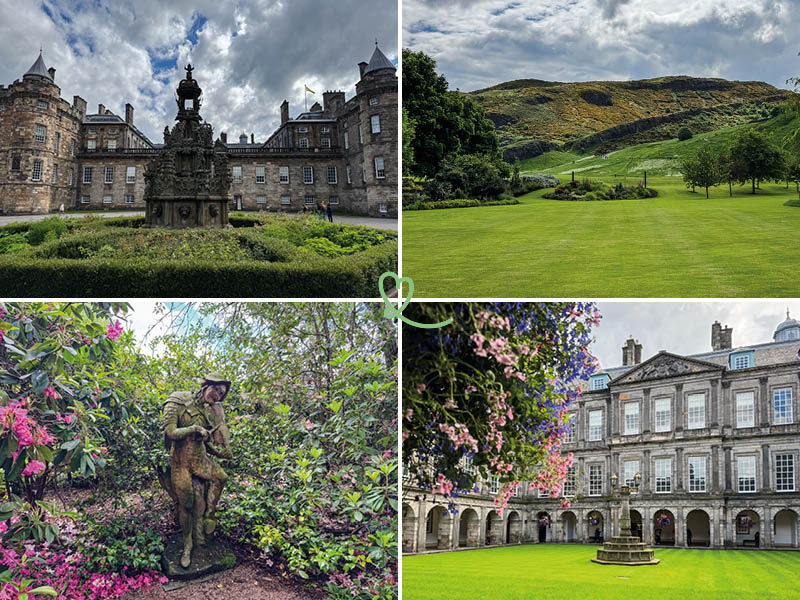
This opinion is completely independent, based on our experiences. We visited the region anonymously, making our own choices and paying our bills in full.
Why visit the Palace of Holyroodhouse?
Is the palace worth it? Our opinion:
Yes, the Palace of Holyroodhouse is well worth a visit for its rich royal heritage and majestic architecture. We were particularly taken with the historic state apartments, adorned with exceptional French and Flemish tapestries. The site is as impressive for its royal gardens as for its unique art collection. It’s one of the best things to do in Edinburgh!

Why is the palace famous?
The Palace of Holyroodhouse is famous for its importance in thehistory of the Scottish and later Britishmonarchy. It was here that many significant historical events took place, most notably around Mary Stuart, whose secretary David Rizzio was murdered in 1566. Today, the palace continues to be the official residence of the British monarch in Scotland.

Our favorite moments
Here are our favorites from the visit:
- The monumental grand staircase
- Mary Stuart’s apartments, steeped in history
- Gardens and view of Arthur’s Seat

History in brief
Here are the major periods in the palace’s history:
- Medieval origins: Holyrood Abbey was founded in 1128 by King David I of Scotland. A royal dwelling was gradually attached to it.
- Residence of the kings of Scotland: from the 15th century onwards, Holyrood became an official royal residence. Notably associated with Mary Stuart and the murder of her secretary David Rizzio in 1566.
- Transformation under the Stuarts: the present palace was rebuilt in the 17th century under Charles II, who turned it into a royal residence with state apartments.
- Royal use and abandonment: after the union of the crowns in 1707, British monarchs stayed here less often, but Holyrood remained a symbol of power in Scotland.
- Current royal residence: today, the palace is the monarch’s official residence in Scotland. It hosts official ceremonies and visits, including Holyrood Week, a tradition established by Elizabeth II.

How to get there: Palace of Holyroodhouse, Edinburgh
Where is the palace?
- On Abbey Strand, at the eastern end of the Royal Mile
- Opposite the Scottish Parliament
- At the foot of Arthur’s Seat

RENT YOUR CAR IN Scotland
- Compare prices on our preferred platform: DiscoverCars – one of the best rated sites.
- Choose a car that’s not too wide, as some roads have only one lane.
- Book early for choice.

See our tips (coming soon)
How to get there?
- The palace is easily accessible by public transport: bus 26 from Waverley Station to Abbeyhill Crescent stop.
- 15min walk from Waverley Station.
- More info here

Parking
- Parking is restricted in the vicinity of the palace.
- Holyrood Car Park, at the foot of Arthur’s Seat, has few spaces and charges apply.
- NCP Holyrood Road, a covered parking lot just a 12-minute walk away.
- For people with reduced mobility, reserved spaces are available on Horse Wynd.

discover edinburgh
- What to do in Edinburgh (coming soon)
- Best hotels (coming soon)
- Best restaurants (coming soon)

Useful tips: duration, schedules, eating…
Best time to visit
- We recommend that you visit the palace in May or September to take advantage of the best weather conditions and extended opening hours. You’ll particularly appreciate the royal gardens during these periods.
- To avoid the crowds, avoid visiting the palace in the morning when it opens. That’s when the tour buses are crowded. Come mid-morning instead.

Length of visit and main difficulties
- The palace tour takes around 1 hour. We recommend you allow 2 hours to enjoy the gardens, café and boutique.
- The palace welcomes around 500,000 visitors a year, which can be quite a crowded affair.
- The Grand Staircase has 27 steps, and some parts, such as Mary Stuart’s rooms, are not wheelchair-accessible.

Advice on how to visit
Just follow the crowd!
- You’ll begin your tour in the historic apartments and state rooms, magnificently decorated with tapestries and portraits of the royal family.
- Then it’s on to the Royal Gallery, an impressive 144 feet long with 96 paintings of the Royal House.
- And last but not least, the ruins of Holyrood Abbey and the Royal Gardens, with a splendid view of Arthur’s Seat.

PLAN YOUR DREAM TRIP AROUND scotland
All the information you need for your trip:
- 15 maps for easy planning
- + 170 pre-selected locations
- Practical advice
- + 170 photos to help you choose

Visiting with children
- The palace offers an interactive tour specially designed for families.
- We particularly liked the Family Room, where your children can enjoy creative activities, fun stories and masquerade costume.
- You’ll also discover interactive games to explore the palace’s history and a Family Garden Trail through the gardens.

Schedules and rates
The palace is open:
- Summer (April to October): 9:30 a.m. to 6:00 p.m.
- Winter (November to March): 9:30 a.m. to 4:30 p.m.
- Closed Tuesdays and Wednesdays
- Closed on December 25 and Good Friday and during royal visits
Adult price: £21 (by reservation), £25 (on the day)
More info on other prices here
We strongly recommend booking in advance.

Guided tours
- An exclusive guided tour of the State Apartments is available on days when the building is closed to the public. More details here
- An audioguide is included in the ticket price and available in 10 languages, offering an interactive and enriching tour of the palace.

Catering
- Café at the Palace offers home cooking with soups, fresh salads and sharing platters, prepared with local ingredients.
- We particularly recommend tea time at £30 per person, or £35 with the sparkling wine option.

Start of the tour: a majestic entrance
The forecourt and sculpted fountain
The forecourt of the palace offers a spectacular first impression of the imposing façade. This is where official ceremonies take place, notably during Holyrood Week. We were intrigued by its Victorian fountain, created in 1858 by Robert Matheson and inspired by the one at Linlithgow Palace in the 16th century. You’ll notice its unique octagonal shape and detailed carvings depicting historical figures, including Queen Margaret and Mary Stuart.

Imposing pairs of corner turrets
The palace’s corner turrets are a remarkable architectural feature. We noted their balanced layout, with one pair to the northwest and another to the southwest. Each turret has a distinctive circular shape and is topped by a conical roof adorned with a ball finial. You’ll also appreciate the two-storey, slightly recessed façade that links these turrets. It creates a beautiful architectural harmony.

Main facade and entrance portal
The palace’s main façade is a masterpiece of architectural symmetry. We were particularly captivated by thebalanced arrangement between James V’s tower to the northwest and its twin tower to the southwest. The main entrance portal is surmounted by the Royal Arms of Scotland and an imposing domed crown. The Doric columns and rows of pilasters framing the façade contribute to the impression of grandeur and majesty typical of palatial architecture.

The tour continues: the royal rooms and court life
The inner courtyard and its colonnaded architecture
At the heart of the palace, the square inner courtyard, measuring around 30 metres on each side, is particularly elegant. We loved the colonnades that stretch across the north, south and east façades. Each features nine majestic arches. Take a good look at the columns! You can admire the refined use of the three classical orders: Doric for the first floor, Ionic for the state apartments and Corinthian for the royal apartments. The visual hierarchy is striking.

The royal apartments and their treasures
The royal apartments are the historic heart of the palace. Unfortunately, we were not allowed to take photos inside the palace. Here you can discover the exceptional collection of French and Flemish tapestries adorning the walls. You’ll also visit the king’s chamber, reserved for the most important personalities, with its sumptuous decorations. A highlight of our visit was the discovery of Mary Stuart’s historic apartments, which tell the fascinating and tragic story of the queen.

End of tour: remains and surrounding nature
The historic ruins of the abbey
Holyrood Abbey, founded in 1128 by David I of Scotland, bears witness to a rich historical past. Although under renovation at the time of our visit, we were struck by the special atmosphere that emanates from these majestic ruins. The abbey was severely damaged during the Scottish Reformation and has remained in the same state ever since.

Royal gardens at the foot of Arthur’s Seat
Originally, it was a simple monastic garden where monks cultivated medicinal plants. Under James IV, the grounds were used for tournaments, falconry and archery. Mary Stuart even brought wild boar from France. The garden you can admire today was redesigned in the mid-19th century by Prince Albert.

Frequently asked questions
Can we take photos inside the palace?
Photography and video recording, including with portable cameras, are not permitted inside the State Apartments of the Palace of Holyroodhouse. However, you may take photographs in the outdoor areas of the palace for non-commercial use.

Is the palace haunted?
The palace is renowned for its ghost stories. The most famous spirit is said to be that of David Rizzio, Mary Stuart’s Italian secretary, murdered in 1566. Visitors have reported unexplained noises and apparitions, particularly in areas linked to David Rizzio’s murder. Agnes Sampson, accused of witchcraft and executed in 1591, is also said to haunt the corridors. You may also hear of dark shapes seen in Lord Darnley’s courtroom and the Queen’s chamber.

