
Getting away from it all in Edinburgh? Don’t miss the Museum on the Mound! Housed in the former headquarters of the Bank of Scotland, the museum tracesScotland ‘s financial development through the centuries, and provides an insight into Scotland’s role inglobal economic history.
In this article, you’ll find some useful tips to help you prepare for your visit and have a great time!
This opinion is completely independent, based on our experiences. We visited the region anonymously, making our own choices and paying our bills in full.
Why visit Museum on the Mound
Is the museum worth it? Our opinion:
Yes, the Museum on the Mound is well worth a visit. We were won over by the richness of its collections, which offer a fascinating journey through Scottish financial history. This free museum also features interactive presentations accessible to all ages, historic coins and the famous £1 million, which you can admire up close. A unique place that combines education and entertainment.
In our opinion, this is one of the best things to do in Edinburgh.

What’s the Museum on the Mound famous for?
The Museum on the Mound is famous for displaying a million pounds sterling in £20 bills, an impressive sight that always captivates visitors. It is also renowned for its iconic location in one of Edinburgh’s most distinctive buildings, theformer headquarters of the Bank of Scotland.
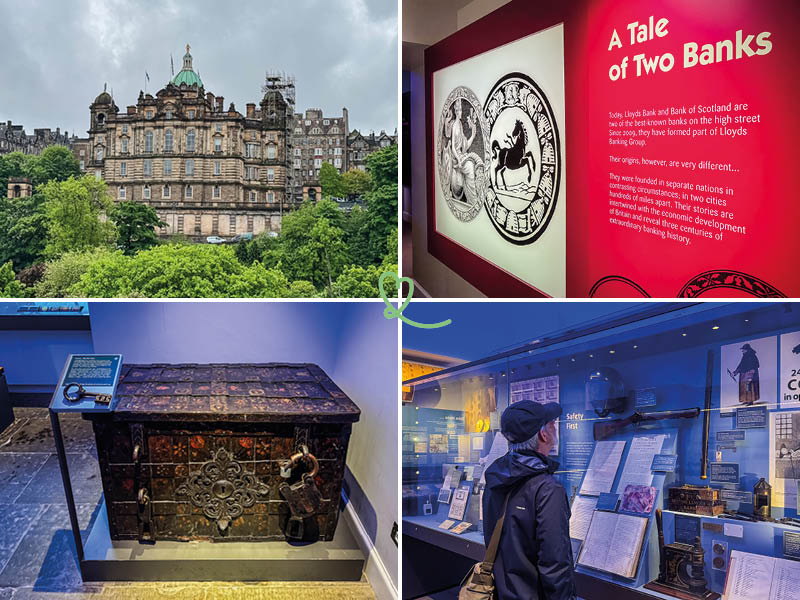
We particularly enjoyed its collection of antiques and artifacts relating to Scottish banking history. You’ll also discover historic safes that bear witness to the evolution of banking security measures.

Our favorite moments
During our visit, we noted several points:
- The million-pound exhibition surprised us: such an impressive sum, physically represented, ultimately takes up very little space.
- The collection of antique safes and coin-counting machines reflects the ingenuity developed over the centuries.
- Finally, the architecture of the building itself, with its breathtaking views of the city from certain windows, even in the rain, was another highlight of the visit.

WHERE TO STAY IN Edinburgh
Our favorites: neighborhoods and hotels
Our selection is coming soon Hotel 1 – See prices, photos and availability
Our selection is coming soon Hotel 1 – See prices, photos and availability
Our selection is coming soon Hotel 1 – See prices, photos and availability

See our complete selection of the best hotels in Edinburgh (coming soon)
History in brief
The history of Museum on the Mound is closely linked to that of banking in Scotland. Here are the main stages in its development:
- 1695: Creation of the Bank of Scotland by an act of the Scottish Parliament
- 1806: Construction of the main building on The Mound
- 1870: Major extension of the building with the addition of a neoclassical façade
- 2006: Museum on the Mound opens in part of the historic building

Access: Museum on the Mound, Edinburgh
Where is the Museum on the Mound?
The Museum on the Mound is located in the heart of Edinburgh, and the address is easy to find: The Mound, Edinburgh EH1 1YZ.
- Edinburgh city center
- On The Mound, on the edge of Old Town
- Close to the Royal Mile
- Above Princes Street Gardens

RENT YOUR CAR IN Scotland
- Compare prices on our preferred platform: DiscoverCars – one of the best rated sites.
- Choose a car that’s not too wide, as some roads have only one lane.
- Book early for choice.

See our tips (coming soon)
How to get there?
The museum is easily accessible from anywhere in Edinburgh.
- We found that the best option was to get there on foot, especially if you’re staying in Old Town.
- From Waverley station, it’s a 5-minute walk up the hill.
- Numerous bus routes serve the area, including those via Princes Street and North Bridge.

Parking
- Traffic and parking in central Edinburgh can be difficult. Street parking is limited and often expensive.
- Pay parking lots are also available nearby, such as Blackfriars Street and Castle Terrace, both a 10-minute walk away.

discover edinburgh
- What to do in Edinburgh (coming soon)
- Best hotels (coming soon)
- Best restaurants (coming soon)

Useful tips: duration, schedules, eating…
Best time to visit
- Weekday mornings are generally quieter, allowing you to explore the exhibits without being rushed.
- If you’re visiting Edinburgh during the August festival, plan an early-morning visit to escape the crowds.
- In short, the first slots after opening or those in the late afternoon (about an hour before closing) will offer you a quieter experience.

Length of visit and main difficulties
- Allow 45min to 1h to explore the entire museum at a comfortable pace.
- The museum is relatively compact but very well organized, making it easy to explore its collections.
- The building is fully accessible to people with reduced mobility.
- You can also download a sensory map from the museum’s website, showing the density of lighting, the intensity of sound and the points of interactivity: light, sound and touch. Find out more here.

Advice on how to visit
We liked the chronological organization of the museum. Just follow the signposted route. The progression gives a good understanding of the evolution of Scotland’s financial system. The explanatory panels are clear and instructive. They guide you naturally from one section to the next.

Guided tours
We didn’t see any mention of guided tours at Museum on the Mound, but laminated guides are available in 5 languages: French, German, Italian, Spanish and… Polish.

PLAN YOUR DREAM TRIP AROUND scotland
All the information you need for your trip:
- 15 maps for easy planning
- + 170 pre-selected locations
- Practical advice
- + 170 photos to help you choose

Visiting with children
The museum is perfectly suited to families.
- Educational booklets are available free of charge at reception for younger visitors, with games and puzzles to guide them through the museum.
- Interactive stations are also available to help younger visitors absorb the information.

Schedules and rates
Museum on the Mound is open:
- Tuesday to Friday: 10 a.m. to 5 p.m.
- Saturday: 1 p.m. to 5 p.m.
- Sunday and Monday: Closed
Price: free of charge. Find out more here.

Diving into the history of coinage in Scotland
The evolution of Scottish currency through the ages
The 8 rooms of Museum on the Mound trace Scotland’s monetary history from its earliest days. We spent a little more time on the ancient coin collection, which bears witness to the evolution of exchange systems over the centuries. You can see coins dating from Roman times to modern coins, including the first specifically Scottish coins minted in the 11th century.

The chronological presentation enabled us to understand how political and economic upheavals influenced the development of the national currency. Of particular interest was theunion of the Scottish and English crowns. It radically transformed the country’s monetary system.

Birth and development of the local banking system
During this visit, we learned that Scotland had been at the forefront of financial innovation in Europe, and in particular, how the Bank of Scotland, founded in 1695, was the first commercial bank created by Act of Parliament in the country.

The presentations also detail the revolutionary introduction of banknotes, an innovation that Scotland adopted long before many other nations. Early calculating machines and original accounting records illustrate the evolution of banking practices. Of particular interest is the story of historic financial crises and how they shaped modern regulations.

Fun and educational experiences around money
Admire a million pounds sterling in banknotes
The highlight of the visit is undoubtedly the million pounds sterling. Its presentation is quite surprising, as it gives a concrete perspective of this considerable sum. Displayed in a secure showcase, the million pounds is made up of neatly stacked bundles of used £20 bills.
We were astonished by the relatively modest volume occupied by this fortune, far less imposing than one might imagine! The installation is complemented by explanations of the security methods used to protect banknotes against counterfeiting.

Creating and financing your own home
Among the fun activities on offer, the “A Home of Your Own” workshop immersed us in the domestic economy of the 1960s. We had fun assembling the different parts of a typical house of the period: a three-bedroom bungalow with garden, garage and modern bathroom.
This interactive model provides a concrete understanding of how a mortgage works and the costs associated with buying a home. Stacking blocks represent the different financial stages, such as the initial deposit, the amount borrowed and the interest to be repaid.

The building’s remarkable architecture
Bank of Scotland’s historic headquarters
The building that houses the Museum on the Mound is an architectural treasure in itself. Built in 1806 and enlarged in 1870, this magnificent neoclassical edifice served as the headquarters of the Bank of Scotland for over two centuries. We were impressed by its imposing facade and its dome overlooking Edinburgh.

A museum perched on an artificial mountain
The museum’s location on The Mound adds another historical dimension to the visit. We learned that this artificial hill had been created from spoil excavated during the construction of New Town. It was an ambitious engineering project designed to link the medieval Old Town with the new Georgian extension to the north (New Town).

Subscribe to our Newsletter
- Get away from it all with Region Lovers’ beautiful destinations!
- Once a month
- Advertising-free

Frequently asked questions
Is there a store at Museum on the Mound?
Yes, there’s a store inside the museum. Here we found objects relating to the history of money, children’s books and educational games on the economy and money, as well as souvenirs, including piggy banks in a variety of colors.

