
Planning a few days in Edinburgh? Don’t miss the chance to climb Arthur’s Seat! This ancient extinct volcano, located in Holyrood Park, rises to an altitude of 251m. It’s an exceptional natural site offering breathtaking views of Edinburgh and the Firth of Forth.
In this article, you’ll find our photos and tips for making the most of your hike to the top of Arthur’s Seat.
This opinion is completely independent, based on our experiences. We visited the region anonymously, making our own choices and paying our bills in full.
Why visit Arthur’s Seat?
Is Arthur’s Seat worth it? Our opinion:
The answer is yes, absolutely! In our opinion, Arthur’s Seat is an absolute must-do when visiting Edinburgh. This unique hike offers a true experience of Scottish nature. A taste of the Highlands in the heart of the city! The views are splendid, over the capital, Leith Harbour and the Firth of Forth. It’s one of Edinburgh’s best activities!

Why is Arthur’s Seat famous?
Arthur’s Seat is famous for its strategic location in the heart of the city. This extinct volcano overlooks Edinburgh, offering spectacular panoramic views of the capital and the Firth of Forth. It is also associated with many legends , one of which tells of a sleeping dragon that once terrorized the region.
Arthur’s Seat has inspired many writers. Among them Mary Shelley and her famous Frankenstein, as well as Jules Vernes(Les Indes Noires) and, closer to home, Ian Rankin and his famous detective Inspector John Rebus. In 2011, the Netflix adaptation of David Nicholls‘ novel One Day, with Anne Hathaway in the title role, further enhanced the site’s reputation.

Our favorite moments
During our hike, we were seduced by..:
- Spectacular views wherever we looked.
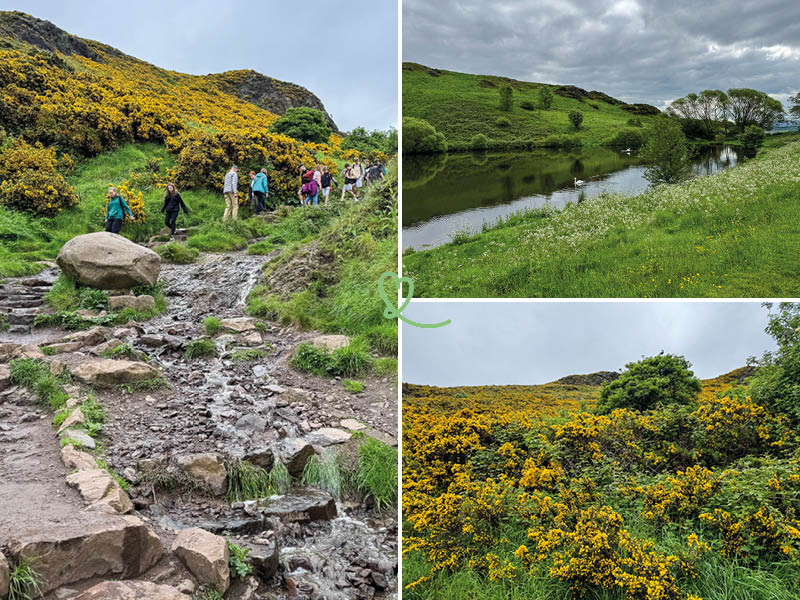
- The broom blossoms (we were there in May) that colored the landscape,
- The lochs (lakes) that added a typically Scottish touch to the experience.

History in brief
Arthur’s Seat is an ancient extinct volcano, 350 million years old. Inhabited since the Iron Age, it is shrouded in mystery and legend. Some associate its name with Arthurian legends, seeing it as a possible site of King Arthur‘s exploits, or even the site of the mythical Camelot.
During our visit, we discovered St Margaret’s Well and its legend: King David I of Scotland was hunting near the spring when he was attacked by a stag. A luminous cross appeared between the animal’s antlers, and it fled. The grateful king builtHolyrood Abbey near this sacred site.

Directions: Arthur’s Seat, Edinburgh
Where is Arthur’s Seat?
Arthur’s Seat is located:
- In the heart of Edinburgh, slightly east of the city center
- In Holyrood Park, near the Palace of Holyroodhouse.

RENT YOUR CAR IN Scotland
- Compare prices on our preferred platform: DiscoverCars – one of the best rated sites.
- Choose a car that’s not too wide, as some roads have only one lane.
- Book early for choice.

See our tips (coming soon)
How to get there?
- Access to Arthur’s Seat is very easy on foot from central Edinburgh: the start of the walk is less than 10 minutes’ walk from the eastern end of the Royal Mile.
- By public transport, bus line 35 (Scottish Parliament stop) is less than 15 minutes’ walk from the start of the walk.

Parking
Several parking options are available:
- We recommend the Holyrood Car Park (fee payable) at the start of the walk, even if it’s not very large.
- A little further up Holyrood Road (at no. 20), we found the Holyrood Road Car Park, a 15-minute walk from the start of the walk.
- Other free alternatives include St Margaret’s Loch and Duddingston Loch parking lots.

discover edinburgh
- What to do in Edinburgh (coming soon)
- Best hotels (coming soon)
- Best restaurants (coming soon)

Useful tips: duration, schedules, eating…
Best time to visit
- We recommend hiking Arthur’s Seat in late spring (May and early June) for pleasant temperatures and flowering, with moderate crowds.
- Autumn (September and October) offers magnificent autumn colors, although the weather is more unpredictable, but isn’t it unpredictable in any season in Scotland?
- To avoid the crowds, visit early in the morning or late in the afternoon.

Length of visit and main difficulties
- Allow around 2h30 to enjoy the hike to the full.
- The climb to the summit takes about 1 hour.
- The climb is quite steep in places, with passages over grass and rocks that can be slippery in wet weather. It is therefore essential to be well-shod and vigilant.

Advice on how to visit
- Several access options are available.
- The main access is from the side of St Margaret’s Well. More details here.
- This was our chosen route. But once at the top, we preferred to head east down Dunsapie Loch to Queen’s Drive.
- Make sure you wear sturdy footwear, keep a hat and raincoat handy and plan your return before nightfall.

PLAN YOUR DREAM TRIP AROUND scotland
All the information you need for your trip:
- 15 maps for easy planning
- + 170 pre-selected locations
- Practical advice
- + 170 photos to help you choose

Visiting with children
The hike is accessible to children, but we recommend that you keep a close eye on them on certain sections. They will need help on the steepest sections.

Schedules and rates
Arthur’s Seat is accessible free of charge every day, all year round.

Guided tours
Why not choose to climb with a guide who will take you to the summit at the best time to enjoy the setting sun? It’s also the assurance of a safe descent in the dark. Click here to book.

Catering
- There are no restaurants on Arthur’s Seat
- It is, however, an ideal spot for a picnic while enjoying the view.
- Whatever you choose, remember to take something to drink and a snack for the hike.
- For a more substantial meal in the warmth, The Sheep Heid Inn, Scotland’s oldest pub, founded in 1360, is located at the foot of the volcano, near Duddingston Loch.

Immerse yourself in Scottish nature right from the start
The unique ambience of trails between moors and hills
There are several paths leading up to Arthur’s Seat. We chose the path opposite Holyroodhouse Palace. The slope is gentle at first, and the path is tarmac. Already, you’re drawn in by the hilly landscape, full of color and gentle curves. A mixture of moorland, meadows and rocky areas. You may be lucky enough to spot the kestrels, partridges and sparrows that populate this area. And maybe even, it seems, a few rabbits.

The striking contrast between wilderness and city backdrop
Arthur’s Seat offers a spectacular setting where wilderness meets urban civilization. As we climbed, views of the city of Edinburgh gradually unfolded, ever wider and more distant. They embraced the historic and cultural heritage of Scotland’s capital, and gave us a clearer idea of the geographical configuration of the site at a glance.

The climb: a gradual ascent and superb views
The pleasure of the climb: between effort and contemplation
Climbing Arthur’s Seat is an experience that harmoniously combines physical effort and contemplation. All along the main trail, we enjoyed a variety of viewpoints, perfect for taking a break and catching our breath. As you gaze out over these wild, often damp expanses, you may be reminded of the ancient custom of inviting young women to wash their faces with the morning dew at sunrise on May 1st, to help preserve their beauty and youthfulness?

Exceptional views from the summit
From the various stops, we were dazzled by exceptional panoramic views. Once at the top, a 360° view awaited us. We were lucky: the horizon was clear. Beyond Edinburgh, we could see the North Sea on one side and as far as the Pentland Hills on the other. We came in the morning but were told that the sunsets were particularly magical and seemed to last an eternity. A great experience to consider.

The descent: peaceful lakes before the urban bustle
Walk along the lakes and enjoy their soothing reflections
On the way back, we didn’t follow the official route. We cut across the meadow to take in other views. Instead of heading south, we turned northeast, towards the sea. Here we found Dunsapie Loch, a man-made lake created by Prince Albert in 1844, a peaceful, bucolic landscape where swans and ducks basked. Further on, you’ll find St Margaret’s Loch.

The unexpected crossroads of the Edinburgh Marathon
Arthur’s Seat is also a popular spot for local runners. You’re bound to come across a few, especially at weekends. On the day of our hike, we came face to face with the many competitors of the Edinburgh Marathon who were enjoying the exceptional setting of this annual competition, more than making up for the effort involved.

Frequently asked questions
Is there a secret tunnel under Arthur’s Seat?
Yes, there is indeed a secret tunnel under Arthur’s Seat, known as theInnocent Railway Tunnel. It is 517 meters long, and its entrance is in the residential area of East Parkside, southwest of Arthur’s Seat. Today, the tunnel is used as a cycle path.

Is it true that 17 miniature coffins were discovered on the slopes of Arthur’s Seat?
Yes, in June 1836, boys hunting rabbits discovered 17 small coffins containing dressed wooden dolls. The enigma of their significance persists to this day, with theories ranging from acts of witchcraft to symbolic burials for sailors or offerings to King Arthur. Today, you can admire eight of these preserved coffins at the National Museum of Scotland.

