
Visiting Edinburgh? Don’t miss the People’s Story Museum! This unique museum traces the history of Edinburgh’s working classes since the 18th century. We were captivated by this authentic approach to Scottish social history, which gives a voice to ordinary workers, servants and craftsmen.
In this article, you’ll find some useful tips to help you prepare for your visit and have a wonderful time!
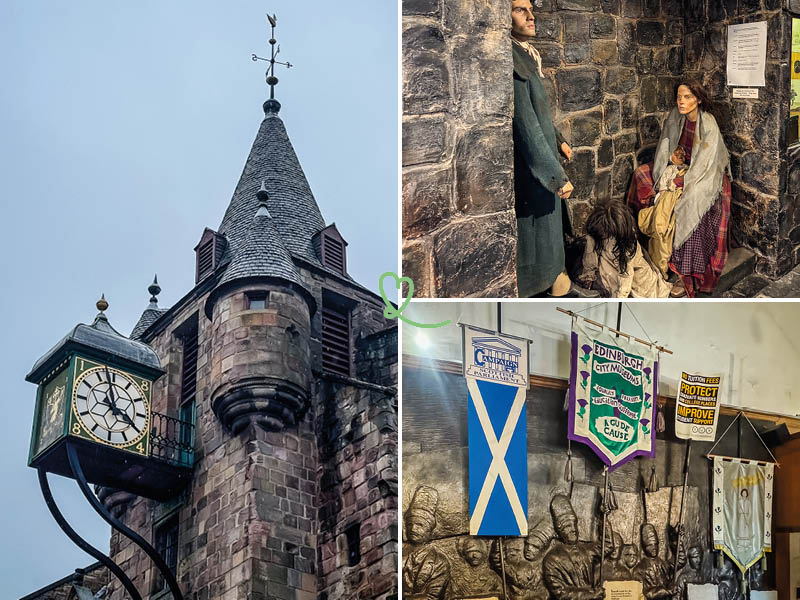
This opinion is completely independent, based on our experiences. We visited the region anonymously, making our own choices and paying our bills in full.
Why visit the People’s Story Museum?
Is the People’s Story Museum worth it? Our opinion:
Yes, the People’s Story Museum is well worth a visit. It allowed us to discover a lesser-known facet of history, focused not on kings or battles, but on the lives of ordinary people. We follow the daily lives of workers, women and modest families, from the 18th century to the present day.
The scenography is sober but effective. The reconstructions, objects and testimonies give an impression of closeness to those who lived there. The visit takes less than an hour, making it an accessible and enriching stopover that complements the city’s other museums.
A visit to this museum is, in our opinion, one ofthe best things to do in Edinburgh.

Why is the People Story Museum famous?
The People’s Story Museum occupies the Canongate Tolbooth, an iconic building recognizable by its distinctive clock-topped tower that dominates the lower Royal Mile. The museum stands out for its unique focus on the history of Edinburgh’s ordinary people.
Unlike traditional museums that focus on famous personalities, this place gives a voice to anonymous citizens. Its exceptional collection of oral testimonies and everyday objects makes it a benchmark for understanding the social evolution of Scotland’s capital.

Our favorite moments
We particularly appreciated it:
- Reconstructions of 19th-centuryworking-class interiors, immersing us in the atmosphere of the time.
- The audio testimonials from Royal Mile residents also touched us with their authenticity.
- Finally, we were fascinated by the richly documented Scottish trade union movements.

WHERE TO STAY IN Edinburgh
Our favorites: neighborhoods and hotels
Our selection is coming soon Hotel 1 – See prices, photos and availability
Our selection is coming soon Hotel 1 – See prices, photos and availability
Our selection is coming soon Hotel 1 – See prices, photos and availability

See our complete selection of the best hotels in Edinburgh (coming soon)
History in brief
Housed in the former Canongate Tolbooth, a 16th-century prison and court building, the museum opened in 1989 to give a voice to Edinburgh’s working classes. It traces the lives of the city’s inhabitants from the 18th to the 20th century through objects, testimonials and reconstructions of everyday scenes. We discover working conditions, domestic life, trade union movements and social struggles. The museum is free of charge and remains a committed place, dedicated to the memory of ordinary people.

How to find us: People’s Story Museum, Edinburgh
Where is the People’s Story Museum?
The museum’s address is 163 Canongate, Edinburgh (EH8 8BN).
- In downtown Edinburgh, on the Royal Mile
- In the Canongate Tolbooth, a historic 16th-century building
- Close to the Palace of Holyroodhouse and the Scottish Parliament

RENT YOUR CAR IN Scotland
- Compare prices on our preferred platform: DiscoverCars – one of the best rated sites.
- Choose a car that’s not too wide, as some roads have only one lane.
- Book early for choice.

See our tips (coming soon)
How to get there?
- Located on the Royal Mile, the museum is easily accessible from central Edinburgh.
- Bus routes 35 and 6 stop nearby.
- From Waverley station, it’s a 15-minute walk.

Parking
- As parking on the Royal Mile is difficult, we recommend you use the Holyrood Car Park.
- However, parking spaces are limited, so you’ll find it easier to park at the St James Centre parking lot, a 15-minute walk from the museum.

discover edinburgh
- What to do in Edinburgh (coming soon)
- Best hotels (coming soon)
- Best restaurants (coming soon)

Useful tips: duration, schedules, eating…
Best time to visit
- We recommend visiting the People’s Story Museum in the morning to avoid the crowds.
- Extended opening hours are available from May to September.
- During the Edinburgh Festival in August, look out for more visitors and a particularly lively atmosphere in the area.

Length of visit and main difficulties
- Allow 1 hour for your complete visit to the museum.
- The building features narrow staircases and passageways.
- Access is limited to the ground floor and 1st floor for people with reduced mobility.

Advice on how to visit
- Start your visit on the first floor, which presents the historical foundations of Edinburgh.
- Then move on to the floor devoted to contemporary testimonies.
- The video room was closed at the time of our visit.

PLAN YOUR DREAM TRIP AROUND scotland
All the information you need for your trip:
- 15 maps for easy planning
- + 170 pre-selected locations
- Practical advice
- + 170 photos to help you choose

Visiting with children
The museum offers family-friendly activities with game booklets to help you discover Edinburgh’s history in an interactive way. There are also period re-enactments to captivate the youngest visitors. Audio testimonials include stories specially selected for young audiences.
- Family-sized sensory backpacks are available for people with neurodivergences or additional support needs (ASN), and can be requested at reception. Find out more here.

Schedules and rates
The museum is open:
- Every day from 10 a.m. to 5 p.m.
- More details here
Rates:
- Free admission for all visitors
- Voluntary donations accepted to support the museum

Catering
The museum doesn’t have a café, but the Royal Mile offers plenty of nearby dining options. We recommend Clarinda’s Tearoom Restaurant, just 3 minutes away, on the same sidewalk.

A glimpse of daily life in Edinburgh from the 18th to the 20th century
We learned a great deal about the living conditions of the servants who made up a large part of Edinburgh’s population. We were able to observe reconstructions of maids’ rooms under the roofs, furnished with a simple bed and a basin.

The apprenticeship contracts on display show how young men were bound to their masters for several years, in a system akin to servitude. This section illustrates the rigidity of the Scottish social hierarchy, where social mobility remained exceptional.

Precarious workers and forgotten trades
The museum highlights the many small trades that sustained Edinburgh’s working classes. We were fascinated by the diversity of activities: water carriers, rag-pickers, street vendors and town criers.

You’ll discover the tools and uniforms of these precarious workers who subsisted from day to day. The testimonies gathered reveal the ingenuity of these men and women who created their own jobs in a flourishing informal economy.

You’ll also learn about the impact of the first industrial revolutions on these traditional trades, many of which disappeared in the face of mechanization and new modes of transport.
The museum offers a fascinating insight into the Scottish justice system and its impact on the working classes. We examined police records documenting arrests for drunkenness, vagrancy and disorderly conduct.

You’ll be able to see a reconstruction of the Tolbooth cell, where offenders were locked up before their trial. The archives on display reveal that punishments mainly affected the poorest, who were often unable to pay the fines.

We also learned about the means of social control exercised by religious and civil authorities, and how the surveillance of morals and behavior shaped the daily lives of Royal Mile residents.
Workers’ awareness and union mobilization
Throughout the rooms, we were able to appreciate the emergence of the Scottish labor movement and its main demands. Banners, posters and union leaflets bear witness to the struggle for shorter working hours and higher wages.

You’ll discover portraits of local trade union figures such as John MacLean, a socialist revolutionary born in Glasgow but active in Edinburgh. The oral testimonies of activists give an insight into the organization of strikes and demonstrations in working-class neighborhoods.

The exhibition also details the creation of the first workers’ cooperatives, which offered economic alternatives based on solidarity to workers and their families.
Women and equality
The museum devotes an important space to the women who left their mark on Edinburgh’s social history through their commitment. We were able to see the careers of local suffragettes who campaigned for women’s suffrage, many of whom were imprisoned for their actions. Personal objects and letters from activists reveal their motivations and sacrifices.

The fight for access to education and skilled professions, long denied to women, is also mentioned. The testimonies of women trade unionists show their crucial role in protest movements, particularly in the textile and food sectors, where they constituted an important but underpaid workforce.

Life stories and memories of the working classes
We particularly enjoyed the contemporary accounts, which give substance to Edinburgh’s social history, especially the stories of former residents of the Royal Mile who recall the transformation of their neighborhood over the decades. You’ll hear accounts of living conditions in the tenements, the typical Edinburgh buildings where several families lived together.

The interviews also reveal community traditions: block parties, mutual aid between neighbors and the transmission of craft skills. The exhibition shows how these communities have managed to preserve their identities despite urban change, creating a collective memory that still nourishes the popular soul of Scotland’s capital today.

Subscribe to our Newsletter
- Get away from it all with Region Lovers’ beautiful destinations!
- Once a month
- Advertising-free

Frequently asked questions
Do I need to book in advance?
No, reservations are not required for individual visits. Admission is free, but a time slot may be recommended for groups.

Is witchcraft on the agenda at the People’s Story Museum?
Not directly. The museum focuses on everyday life and social struggles, but some stories from the past evoke popular superstitions and beliefs, particularly in poor neighborhoods.

